12 min read
Scata and the Castagniccia in the Great War: the soldier of 1916, the war memorials and the memory of the villages
Scata in the Great War: 170 people in 1911, 124 in 1921, a plaque in the church. Corsica in WWI, its dead, its villages, and a WWI soldier you can talk to.
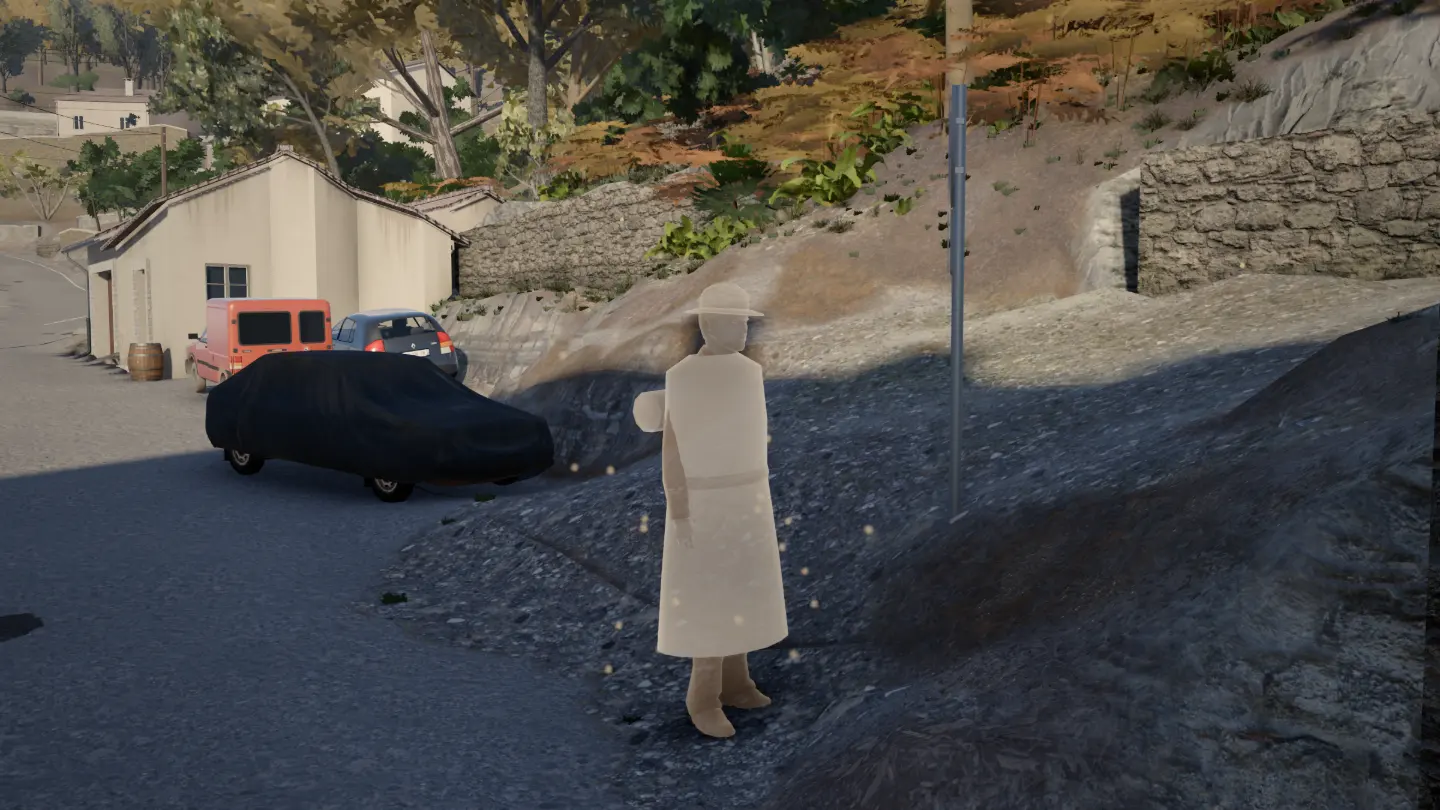
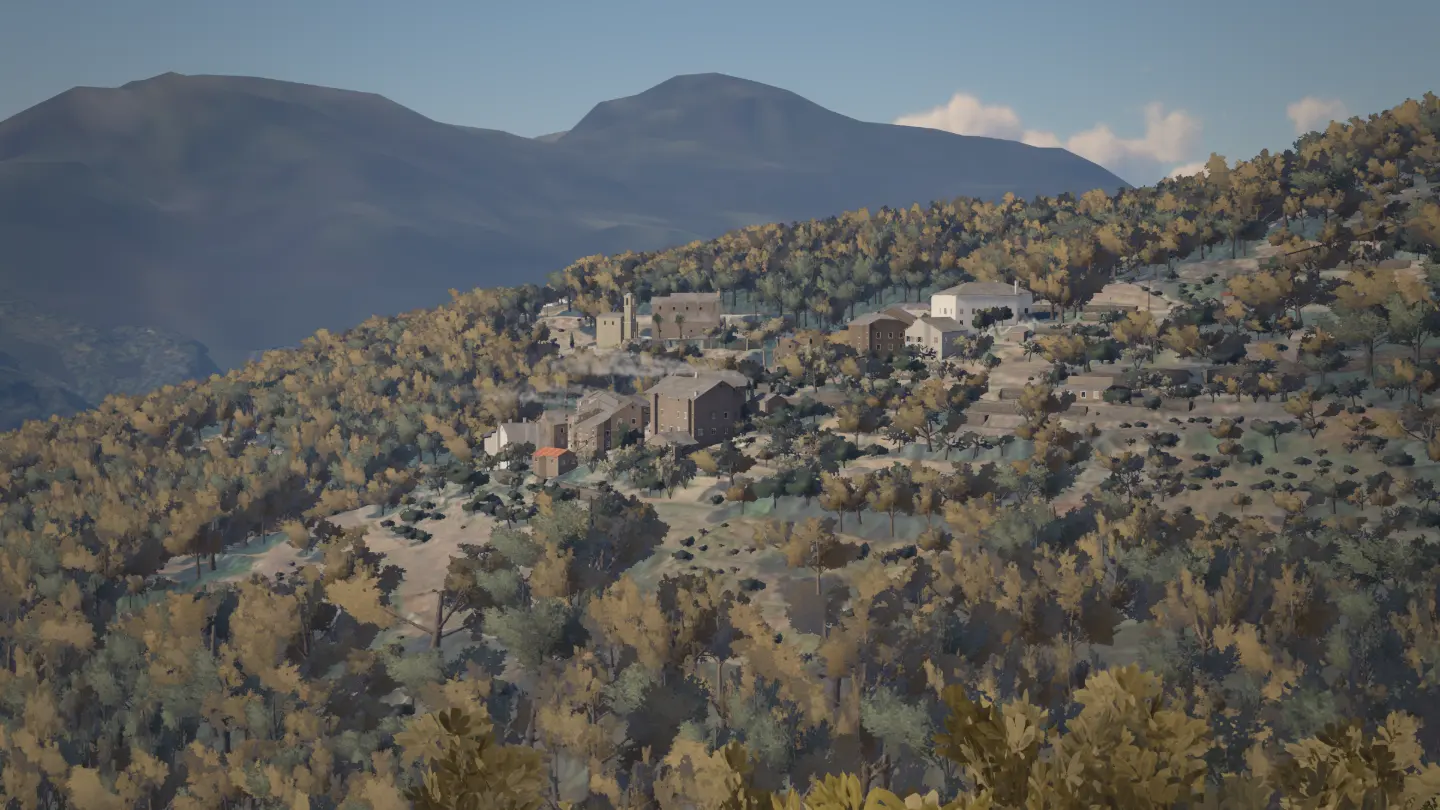
In 1911, Scata, a small hilltop village of the Ampugnani in the Castagniccia, in north-eastern Corsica, had 170 inhabitants. By 1921, 124 were left. In between came the Great War. From those years the village keeps a plaque in its church, numbers that do not quite agree, tannin works closed not far away, and a population that never really recovered. Here is what the sources say about Scata first, then about the Castagniccia and about Corsica in the war of 1914–1918, with the historians’ debates, neither softened nor inflated. And in the game Fiumalta, which recreates the village, a soldier of 1916 waits for you at the bottom of the houses: you can talk to him and ask him your own questions, about his leave, his regiment, the front or what the war cost the village.
Scata and the Great War at a glance
- Where: Scata, a commune of Haute-Corse in the old piève (parish district) of Ampugnani, in the Castagniccia, above the Fium’Alto valley.
- The village: 179 inhabitants in 1906, 170 in 1911, 124 in 1921, a quarter fewer in ten years, between the war and departures.
- The memory: a plaque in the church of Sainte-Cécile serves as the 1914–1918 war memorial. How many names it bears is not established.
- Corsica: about 52,800 men mobilised and 11,000 dead according to the historian Jean-Paul Pellegrinetti; 11,691 dead according to a name-by-name count published in 2024. The figure of 40,000 dead, long repeated, is a post-war myth.
- The regiment: the 173rd infantry regiment, known as “the Corsican regiment”, was at Verdun from May 1916 to August 1917.
- In the game: in Fiumalta, a soldier of the 173rd on leave in 1916, an invented character labelled as such, answers your questions out loud.
Scata, a Castagniccia village at war
A quarter of the village in ten years. The censuses, gathered by the EHESS, tell the fall without comment: 179 inhabitants in 1906, 170 in 1911, 124 in 1921. Forty-six fewer people between the last two counts, more than a quarter of the village. Not all of it is the dead of the front: the Castagniccia, the most populous countryside of the island in the 19th century, was already starting to empty around 1900, and the census does not say how many died at the front and how many left. After a rebound to 140 in 1946, the exodus resumed: 59 in 1975, 32 in 1990, the lowest point. There were 41 in 2023.
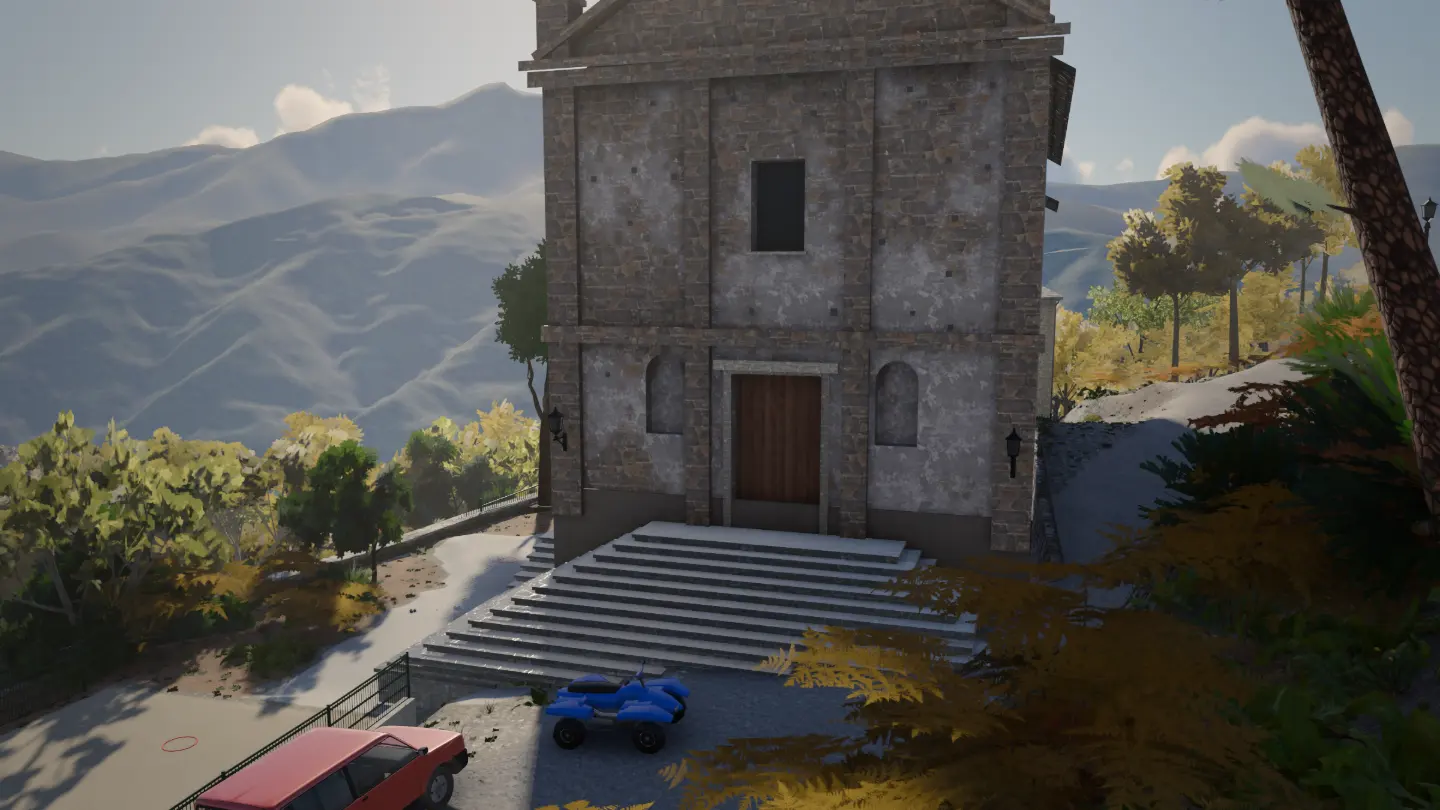
A plaque for a memorial. According to the Université de Lille’s war-memorial database, cited by Wikipedia, it is a church plaque that serves as Scata’s memorial for the 1914–1918 war. OpenStreetMap, for its part, puts a memorial on the forecourt of Sainte-Cécile, the parish church. Inside or outside: with no published photo, we cannot say.
How many names? Here the sources disagree. An amateur survey of Corsica’s war memorials, Cronica di a Corsica, counts on one page a single name for 1914–1918 at Scata and nine “missing” natives, sons of the village who died in the war but are not listed here; on another page it gives three names. We do not publish these names: the list is unverified, and the families still live in the village. The disagreement still says something true: the memory of a small Corsican village is scattered. A man born in the village but settled elsewhere may be listed on another commune’s memorial, or on none: according to O.-G. Caporossi’s count, 1,281 Corsican soldiers recognised as “morts pour la France” appear on no memorial on the island, most of them born outside Corsica.
A link with the 173rd. Among the people linked to the commune, Wikipedia lists a captain of the 173rd infantry regiment, a knight of the Légion d’honneur. He died less than a hundred years ago and his family lives in the region: we do not name him.
A valley without its works. The war also struck work. By the Fium’Alto, within the commune, the Fabbrica Vecchia had opened in 1873: the island’s first works to draw gallic acid from chestnut wood, used mostly to dye silk black. In 1882 its director went into partnership with tanners from Longjumeau and the business moved to Campo Piano, in the commune of Pruno, where a tanning-extract works was born. These tannin works were the island’s only industry to employ mostly local people: nearly 400 workers in Corsica between 1900 and 1914. Then Campo Piano and Casamozza closed in 1914. At Casamozza, the works belonged to a Berlin firm, Levinstein and Sons, and employed about a hundred workers: it closed the day after war was declared, and it was destroyed. For the families of the area, the war took the men and, at the same time, wages.
The soldier of 1916: a WWI soldier you can talk to
In Fiumalta, the game that recreates Scata under that name, a soldier of the 173rd infantry regiment stands at the bottom of the village, by the road, a few metres before it ends, facing the street that runs down between the houses. He is on leave for a few days, in 1916, the year his regiment is at Verdun.
An invented character, and said to be one. This soldier is fiction: he has no name, he is not one of the village’s dead, and the game marks him with the “Fiction” badge. What he tells, on the other hand, comes from sourced facts: the regiment, the dates, the numbers. He carries no weapon, he stays away from the memorial, and he never talks about violent details. Like the game’s other figures of the past, he fades away on 1, 2 and 11 November.
Talk to a WWI soldier. This is where the game becomes a living history lesson: you can have a conversation with him. Walk to within three metres, press E and speak into your microphone: he answers out loud, live, like the game’s villagers. No microphone? Type your question in the chat and he answers aloud. He speaks English if you play or talk to him in English, French otherwise, with the odd Corsican word. You can ask him, for example:
- “How long is your leave?”
- “What happened at Verdun?”
- “How many people lived in the village before the war?”
He also knows why his regiment is called “the Corsican regiment”, how it left the island in August 1914, how many men the 173rd lost and what the war cost Corsica. His answers come from the village’s sourced knowledge base, the same one the villagers and the other figures use. His memory stops in 1921: he knows nothing of what came after. Like any artificial intelligence, he can make mistakes; the facts in this article, for their part, are sourced below.
The 173rd, “the Corsican regiment”
A brand-new regiment. The 173rd infantry regiment was created in Nice on 15 April 1913. In September 1913 it came to garrison Corsica, at Bastia, Ajaccio, Corte, Calvi, Bonifacio and Sartène. It was called “the Corsican regiment”, but not all its soldiers were Corsican: they came from all over France. In August 1914, the island’s reservists filled its ranks.
Departure. General mobilisation began on 2 August 1914. The regiment gathered at Ajaccio, embarked on the evening of 9 August and landed at Marseille the next day; the train took it east. On 15 August it took up position south-east of Nancy, and on 20 August 1914 it fought its first battle at Dieuze, in Moselle.
Verdun. From May 1916 to August 1917, the 173rd was in the battle of Verdun: its flag bears the inscription “Verdun 1916”. It received four citations in army orders and the fourragère. The price was terrible: there are 3,451 graves of its soldiers, and the regiment’s veterans’ association honours 3,633 dead.
Leave, and the crossing. Leave only came in the summer of 1915: eight days, then six; from 1 October 1916, seven days per four-month period, in principle, though the rule was applied unevenly. From 1 February 1917 the journey came on top: one day for a 401–800 km round trip, two for 801–1,600, three for 1,601–3,000, four beyond; the train and, where needed, the steamer were free for men on leave. On 1 October 1917 leave rose to 30 days a year: three times ten days for mainland France and Monaco, but twice fifteen days for those going home to Corsica.
Return. After the armistice, the regiment occupied the Rhineland. On 1 January 1920 its flag came back to Corsica, at Bastia, after some 2,000 days away.
Corsica in the war: what historians say
The numbers. For Jean-Paul Pellegrinetti, author of Une île dans la guerre. La Corse, 1914-1918 (2020), Corsica mobilised nearly 52,800 soldiers, and 11,000 died. A name-by-name count by Orsu Ghjuvanni Caporossi, published by Corse Net Infos in 2024, estimates 11,691 islanders dead: 10,773 are officially recognised as “morts pour la France”, 10,409 names are carved on war memorials in Corsica, and 1,281 recognised soldiers appear on no memorial on the island.
One in four, or one in five? Interviewed by Corse Net Infos in 2025, the historian Sylvain Gregori, curator of the Bastia museum, speaks of 40,000 mobilised and 11,000 killed: “one poilu in four”. The article itself writes that nearly 40,000 men left for the front and calls it “the highest rate in France”. With Pellegrinetti’s 52,800 mobilised, the share would rather be one in five. The number of dead is now fairly sure; it is the number mobilised, and so the rate, that varies between authors.
The myth of the 40,000 dead. For decades, people in Corsica said the island had lost 40,000 men. For Sylvain Gregori, it is a popular myth born of “a real trauma”: “everyone” had a father, a brother or a husband who had not come back. The figure was taken up and recognised by the island’s political elites. It was only abandoned in the 2000s, when historians counted, commune by commune, the names carved on the war memorials. It still circulates online.
A mobilisation felt as an injustice. From 1914, fathers of large families who were not of an age to be mobilised were sent to the front; this was regularised in the following months, under pressure from the population and elected officials. This heavy and unequal mobilisation remained a grievance. It fed the autonomism of the inter-war years: for the autonomists, Corsicans had “served as cannon fodder for France”, and the Corsican autonomist party was founded by Petru Rocca, a veteran. Around the newspaper A Muvra, in 1920, autonomists called for autonomy; part of them later drew close to Fascist Italy, which claimed the island. These are two readings of the same grief, and we give them for what they are: a grievance resting on facts, and a political interpretation. The rest of this story is in our article History of Corsica: from Pasquale Paoli to today.
The memory of the Castagniccia villages
One memorial per commune. It was by counting the names commune by commune that historians put an end to the myth of the 40,000 dead: in Corsica, the memory of the Great War is first of all the villages’ business. In the Castagniccia as elsewhere, the list of the dead is carved there, on a memorial or, as at Scata, on a church plaque. Caporossi’s numbers also show the gaps in that memory: 1,281 soldiers recognised as “morts pour la France” are listed on no memorial on the island, and 918 carved names are not officially recognised. In the neighbouring villages too, the names are carved on the spot: at La Porta, the war memorial honours the village’s dead of 1914-1918 and of Indochina; at Pie-d’Orezza, it is on the church and also bears the dead of the Second World War.
Villages emptying. The war sped up what had begun before it. For Sylvain Gregori, the island’s economy collapsed after the war and emigration accelerated. At Scata, the 1921 census falls to 124 inhabitants, then to 94 in 1936. Down in the valleys, the tannin works of Campo Piano and Casamozza did not reopen.
The night of the dead. The Castagniccia also has its own way of remembering. In Corsica, on the night of 1 to 2 November, people left bread, boiled chestnuts and water on the table for the dead who come back to visit the house; in the Castagniccia, chestnuts were taken to the church. It is a night of recollection, not a festival.
What we do not know. The exact text of Scata’s plaque, how many names it bears, its exact place in the church or on the forecourt, the names of the village men who died at the front: none of this is reliably published. These are questions for the town hall and the elders. If you know the plaque, it is the best source.
Discover it in the game: talk to the soldier of 1916
Fiumalta is a free multiplayer game that you play in your browser, with no download and no account, in an Ampugnani village recreated from the sources. To meet the soldier of 1916:
- Enter the village from the home page, on a computer, phone or tablet.
- Find him at the bottom of the village, by the road: the map (M key) and the activities board show the figures of the past, and “Guide me” takes you there. The guided tour of the village also stops on the Great War, and you pass him on the way down.
- Walk up and press E: talk to him into your microphone, or type your question in the chat. He answers out loud, live; subtitles are available in the settings. If voices are switched off, he tells you his story in five written lines, each with its badge (History or Fiction), and its sources when it is history.
Ask him about his leave, his regiment, Verdun, the village before the war or the number of Corsicans who died: he answers from the game’s sourced facts, like Pasquale Paoli by the fountain or Countess Mathilde where the path named after her leaves the village. When you leave him, walk up to Sainte-Cécile: it is there, in the church, that the village has kept the memory of its own. It is only a game; the real plaque is at Scata.
Frequently asked questions
How many Corsicans died in the First World War?
About 11,000 according to the historian Jean-Paul Pellegrinetti, out of some 52,800 men mobilised. O.-G. Caporossi’s name-by-name count, published in 2024, estimates 11,691, of whom 10,773 are officially recognised as “morts pour la France” (died for France).
Where does the figure of 40,000 Corsican dead come from?
From post-war memory: a popular myth born of the families’ trauma and taken up by the island’s political elites, according to the historian Sylvain Gregori. It was abandoned in the 2000s, when historians counted the names on every commune’s war memorial.
Why was the 173rd infantry regiment called “the Corsican regiment”?
It had been garrisoned in Corsica since September 1913, and the island’s reservists filled its ranks in August 1914; yet not all its soldiers were Corsican.
Does Scata have a war memorial?
According to the Université de Lille’s war-memorial database, a plaque in the church serves as the memorial for the 1914–1918 war. The number of names is not established: an amateur survey gives figures that do not agree.
Can you talk to a WWI soldier in a game?
Yes: in Fiumalta, a free game in the browser, a soldier of the 173rd on leave in 1916, an invented character, stands at the bottom of the village. Walk up, press E and ask him your questions out loud, or type them in the chat if you have no microphone: he answers aloud, from the game’s sourced facts.
Read more
- History of Corsica: from Pasquale Paoli to today, the key dates
- The castellu di Lumitu and the chapel of San Martinu: the Cortinchi lords’ castle at Scata
- Castagniccia: what to see and do — a guide to its villages, convents and chestnut woods
- The Corsican chestnut: history, AOP flour, festivals and recipes
- Corsican culture and legends: paghjella, mazzeri, evening gatherings and the Corsican language
- Hiking in the Castagniccia: 5 walks between hilltop villages and chestnut woods
- Rebuilding a whole village as a multiplayer game with AI
Sources
- EHESS, Des villages de Cassini aux communes d’aujourd’hui, Scata (censuses)
- Wikipédia (fr), “Scata” (places and monuments, population, people linked to the commune)
- Université de Lille, Les monuments aux morts, record 51232 “Scata” (a church plaque serving as the memorial; the database now redirects)
- Cronica di a Corsica, Monuments aux morts corses: Scata (amateur site)
- Ph. Jammes, “Guerre de 14-18 : le 173e R.I., le régiment des Corses”, Corse Net Infos, 11 November 2020
- V. Leonardi, on Jean-Paul Pellegrinetti’s Une île dans la guerre, Corse Net Infos, 19 March 2020
- “11-Novembre : combien de Corses sont ‘morts pour la France’ ?” (O.-G. Caporossi’s study), Corse Net Infos, 10 November 2024
- L. Serve, “107 ans après l’Armistice, la Corse reste marquée par la Grande Guerre” (the historian Sylvain Gregori), Corse Net Infos, 10 November 2025
- Geneawiki, “Guerre 1914-1918 ~ Les permissions”
- TracesOfWar, “War Memorial La Porta”
- TracesOfWar, “War Memorial Pie-d'Orezza”
- POP (Inventaire), the gallic-acid works known as Fabrica Vecchia, Scata, IA2B000621
- POP (Inventaire), the Campo Piano chemical works, Pruno, IA2B001097
- POP (Inventaire), the Casamozza tanning-extract works, Lucciana, IA2B000609
- P.-J. Campocasso, the gallic-acid works of Corsica, ADLFI
- Corse Net Infos, “DOSSIER. Le châtaignier et la Corse”, 11 December 2022
- Corse Net Infos, “Notte di i morti en Corse”, 1 November 2023
- Wikipedia, “Corsican nationalism”