7 min read
The Corsican flag: the origin and meaning of the Moor’s head, from Aragon to Pasquale Paoli
The Corsican flag’s Moor’s head: its Aragonese roots, Theodore of Neuhoff in 1736, Paoli’s flag of 1762, the blindfold myth, the legends and its use today.
A white flag with a black head in profile, a white headband tied around it: the Moor’s head, a bandera testa mora in Corsican, flies over town halls, harbours and stadiums all over the island. Few flags are so recognisable, and few have an origin so debated. Here is what the sources say: where the Moor’s head comes from, how a German adventurer and then Pasquale Paoli made it Corsica’s flag, what the famous blindfold is about, and what the legends tell.
The Corsican flag at a glance
- What it shows: a black Moor’s head in profile on a white field, a white headband tied on the forehead.
- Its name: a bandera testa mora (the Moor’s head flag) in Corsican, la tête de Maure in French.
- Its likely origin: the arms of the Crown of Aragon, where Moors’ heads appear in 1281; the Pope granted Sardinia and Corsica to the King of Aragon in 1297.
- The flag of the nation: under Pasquale Paoli, adopted by the Corsican Republic on 24 November 1762 at Corte according to Wikipédia.
- Today: the flag of the Collectivité de Corse (adopted by the Région de Corse in 1980), and, in the words of the Flags of the World site, the emblem of all Corsicans.
Where does the Moor’s head come from?
Historians mostly look towards Aragon. A Moor’s head first appears in 1281, on a seal of King Peter III of Aragon, and the Aragonese arms came to show four Moors’ heads around a red cross. A story often told, without solid evidence according to Flags of the World, links them to a victory over four Moorish kings at Alcoraz. In 1297 Pope Boniface VIII created a kingdom of Sardinia and Corsica and gave it to the King of Aragon: on paper at least, Corsica entered the Aragonese world, though Aragon held the island only briefly and partly.
The Corsican head itself is documented from the late 14th century: the Gelre armorial, a herald’s book of arms of that time, gives Corsica a Moor’s head with its eyes uncovered. The historian Michel Vergé-Franceschi, in Aux origines de la tête de Maure (Albiana, 2024), dates this oldest known Corsican Moor’s head to 1370–1404 and points out that it is a bust, its headband over the brows, not a severed head like the four bleeding necks of the Aragonese and Sardinian arms. His thesis: the Corsican head is a corsair, the knotted cloth worn against sweat and sea spray, on an island he calls casa di Corsari.
That is why the flags of Sardinia and Corsica look alike: the same Aragonese source, two different paths. Sardinia kept the four heads (shown blindfolded for a long time, with the headband raised on the official flag since 1999); Corsica kept one.
Theodore of Neuhoff, the king of 1736
In the 1730s the Corsicans were in open revolt against Genoa. On 12 March 1736 a Westphalian baron, Theodore of Neuhoff, landed at Aleria with weapons and money, dressed in an oriental caftan. On 15 April, at the convent of Alesani in the Castagniccia, the insurgents’ assembly proclaimed him King of Corsica. His flag was white with a Moor’s head, and his coins bore it too.
His reign lasted a few months: he left the island in November 1736 to look for help and never truly ruled again. But the Moor’s head had been carried as the emblem of a Corsican state, and Flags of the World suggests that his brief popularity helped make it the island’s symbol from then on.
Pasquale Paoli and the flag of the nation
Pasquale Paoli, born at Morosaglia in the Castagniccia in 1725, was elected General of the Nation in 1755 and gave Corsica a written constitution the same year (see our article on the key dates of Corsican history). The independent nation needed its symbols. According to Flags of the World, Paoli proposed a flag in a letter of 23 June 1760; the consulta of Vescovato decided on 24 May 1761 to mint coins with the arms of the Kingdom of Corsica; and Wikipédia dates the flag’s adoption by the Corsican Republic to 24 November 1762, at Corte. From then on the Moor’s head, its headband on the forehead, was the flag of Paoli’s Corsica.
The oldest known Corsican flag dates from those years. Kept at the Musée de Bastia, dated by family tradition to 1755–1768, it belonged to Giuseppe Maria Massesi (1716–1791), Paoli’s Grand Chancellor. Its Moor wears a pearl necklace and earrings, under a crown for the Regno di Corsica; the museum showed it to the public in December 2014.
The flag outlived the republic. After the defeat at Ponte Novu in 1769, France kept the head on the island’s arms (without its headband, and with royal lilies until the Revolution); the short Anglo-Corsican Kingdom of 1794–1796 quartered the Moor’s head with the British arms.
The blindfold: legend and history
The most famous story about the flag is about the headband. It is said that the Moor was first blindfolded, the sign of a people kept in the dark, and that Paoli raised the cloth onto the forehead to show that Corsica had opened its eyes. Other versions credit the act to Gian Pietro Gaffori in 1735, to Theodore, or even to Napoleon.
The sources are much more cautious. Flags of the World cites Genoese archives that already show flags with the headband on the forehead in 1731, before Theodore and Paoli. Wikipédia reports that, for several historians, the move from the eyes to the forehead “never took place”: no Corsican blindfolded Moor is attested before then. The blindfold belongs above all to Sardinia, whose four Moors were long shown with their eyes covered. The meaning given to the raised headband (freedom, a nation awake) is real, as a meaning Corsicans have given it; the story of the gesture is a legend.
The legends of the Moor’s head
Corsica has its own explanations, told and retold:
- Diana and Paolo: a young Corsican woman, Diana, is carried off by the Moor Mansour Ben Ismaïl; her fiancé Paolo frees her and brings back the head of her captor, which the villagers then carry as their banner.
- Ugo Colonna: in the island’s medieval chronicles, the Roman count Ugo Colonna drives out the Moors and beheads their king; the head becomes the sign of victory.
- Saint Maurice: some have looked to the black saint Maurice, but Wikipédia calls the idea unlikely.
None of these stories is history: they say how Corsicans made the Moor’s head their own, long after it arrived.
The flag today
The Région de Corse adopted the Moor’s head as its flag in 1980; it is now the flag of the Collectivité de Corse. It belongs to everyone on the island, nationalists and others alike: Flags of the World calls it “the emblem of all Corsicans”. Some would like to see it go further: in 2022 a Corsican sculptor proposed busts of the Moor’s head for the island’s town halls, next to the French Republic’s Marianne.
The flag has two companions among Corsica’s national symbols. In January 1735 the consulta of Orezza, in the Castagniccia, put the nation under the protection of the Virgin: the hymn Dio vi salvi Regina became the Corsican anthem, and 8 December is still kept as the national feast.
Meet Theodore and Paoli in the game
Fiumalta is a free multiplayer game that you play in your browser, with no download and no account, in a Castagniccia village recreated from the sources. Two of the figures of the past you meet there are the men of the flag:
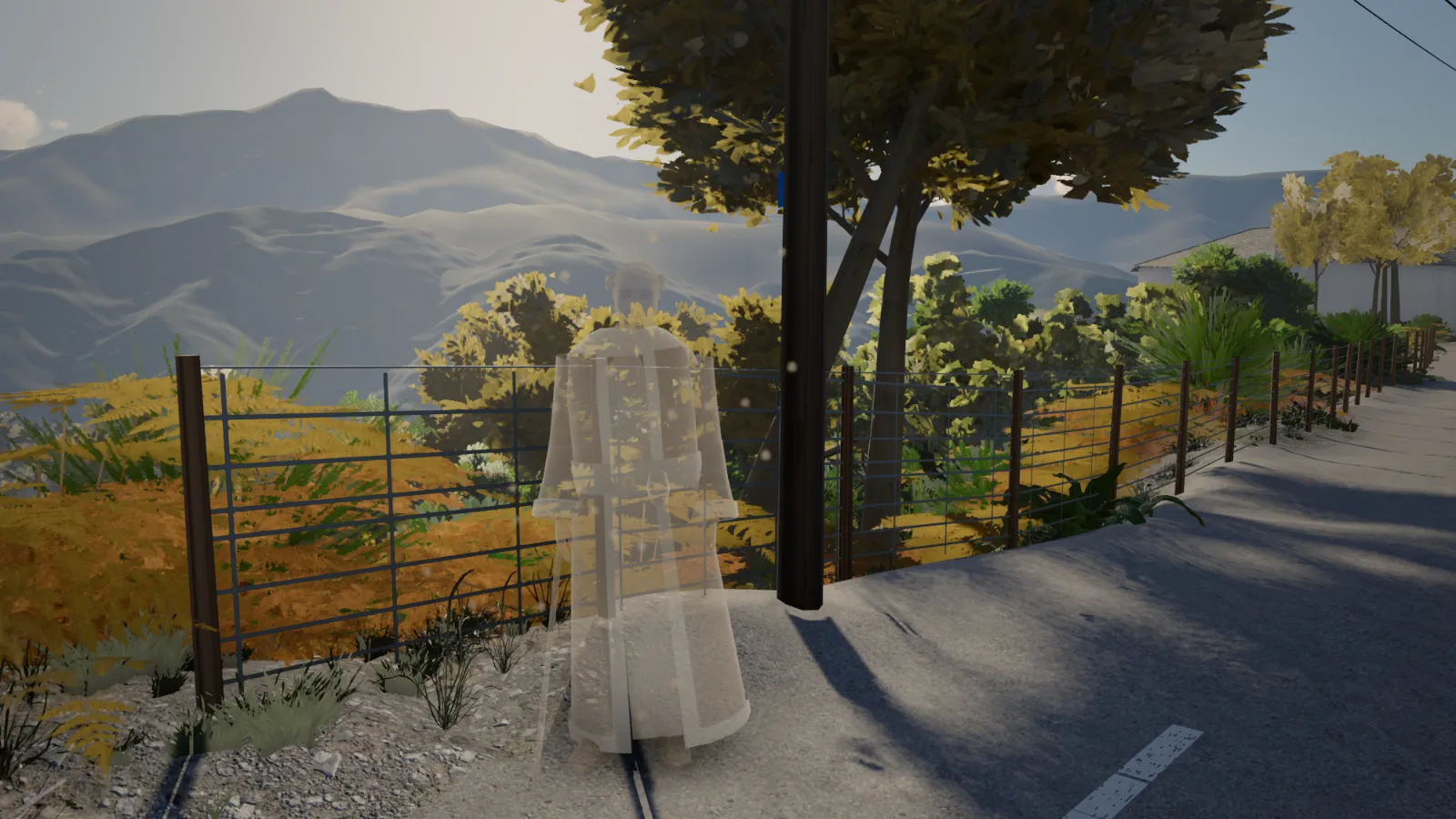
- Theodore of Neuhoff stands by the road out of the village to the south, towards Orezza and Alesani, where he was proclaimed king: a translucent figure in a long caftan, leaning on his cane.
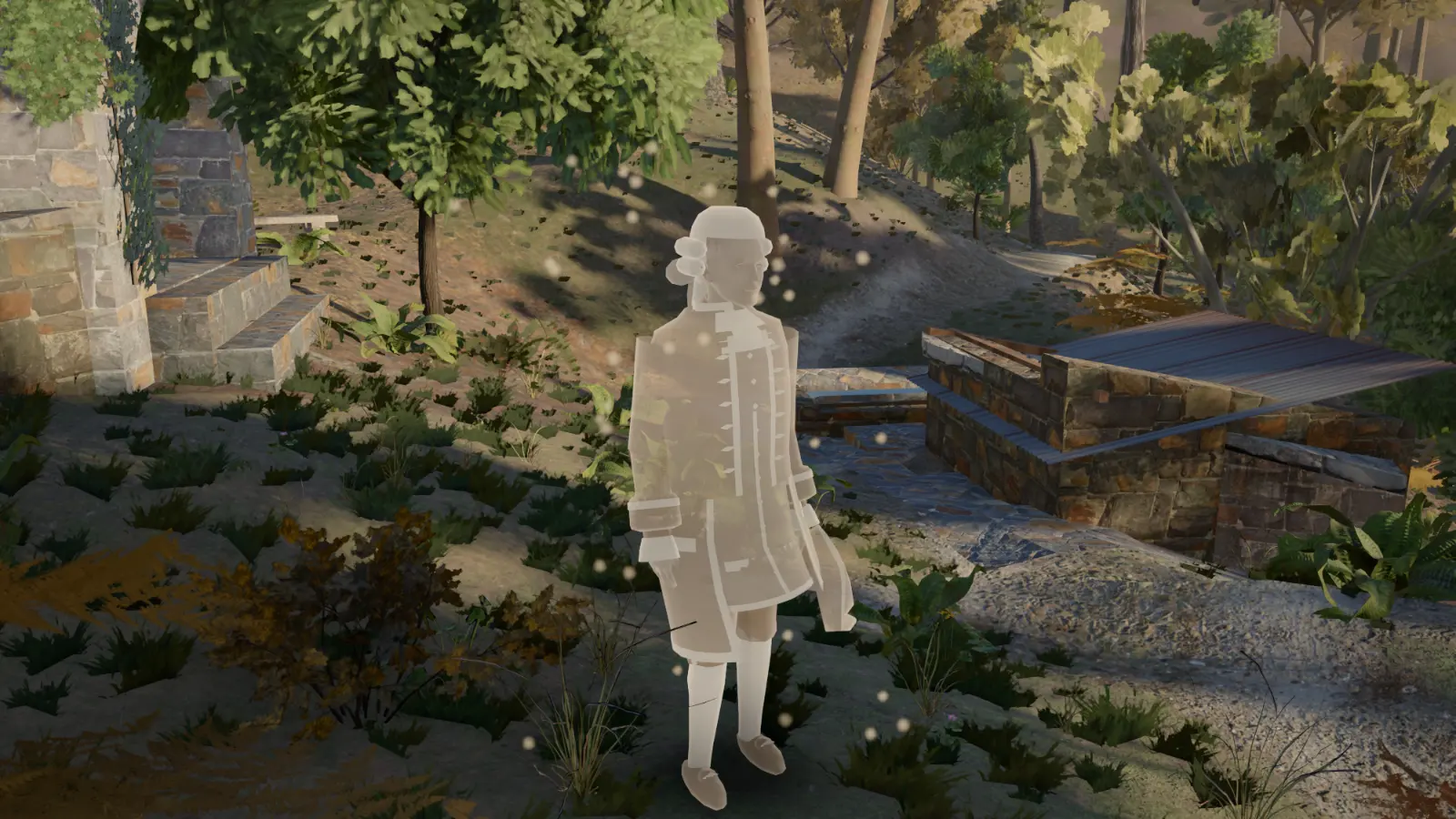
- Pasquale Paoli waits by the fountain below the village, on the path through the chestnut wood, in his powdered wig, his tricorne in his hand.
- Walk up and press E: ask them out loud about the Moor’s head, the kingdom of 1736 or the constitution of 1755, or type your question in the chat. They answer aloud, live, from the game’s sourced facts; the map (M key) and “Guide me” take you to them.
It is only a game; the real flag of Paoli’s chancellor is in Bastia.
Frequently asked questions
What does the Moor’s head on the Corsican flag mean?
No one knows for sure. The emblem probably came from the Crown of Aragon, whose arms showed Moors’ heads from 1281 and to which the Pope granted Sardinia and Corsica in 1297. Under Pasquale Paoli it became the flag of independent Corsica, and the headband worn on the forehead is often read as the nation’s eyes opened, though historians doubt that it was ever moved from the eyes.
Why is the Moor on the Corsican flag blindfolded or not?
On the Corsican flag the headband is on the forehead. A popular story says it once covered the eyes and that Paoli (or Gaffori, or Theodore) raised it as a sign of freedom; but Genoese archives already show the headband on the forehead in 1731, and several historians say the blindfold never existed in Corsica. Sardinia’s four Moors were long shown blindfolded.
When was the Corsican flag adopted?
As the flag of the nation, under Pasquale Paoli: Wikipédia dates its adoption by the young Corsican Republic to 24 November 1762 at Corte, after a proposal in Paoli’s letter of 23 June 1760. The Région de Corse, today’s Collectivité de Corse, adopted it in 1980.
Why do the Corsican and Sardinian flags look alike?
Both islands formed a kingdom that Pope Boniface VIII created in 1297 for the King of Aragon, whose arms had four Moors’ heads around a red cross. Sardinia kept the four heads; Corsica has a single head, which the historian Michel Vergé-Franceschi reads as a corsair rather than a defeated Moor.
Can you meet Pasquale Paoli or Theodore of Neuhoff in a game?
Yes: in Fiumalta, a free game in the browser, both are figures of the past in a recreated Castagniccia village. Walk up, press E and ask them about the flag out loud, or type your question in the chat: they answer from the game’s sourced facts.
Read more
- History of Corsica: from Pasquale Paoli to today, the key dates
- Corsican culture and legends: paghjella, mazzeri, evening gatherings and the Corsican language
- Castagniccia: what to see and do — a guide to its villages, convents and chestnut woods
- The castellu di Lumitu and the chapel of San Martinu: the Cortinchi lords’ castle at Scata
- Rebuilding a whole village as a multiplayer game with AI
Sources
- Wikipédia (fr), “Drapeau de la Corse”
- Wikipedia, “Flag and coat of arms of Corsica”
- Flags of the World, “Corsica (France, Traditional province)” (I. Sache, O. Touzeau, A. Martins)
- Ch. Monti, “Bastia : le plus ancien drapeau corse connu, exposé au musée”, Corse Net Infos, 8 December 2014
- E. Mas, “Pourquoi les drapeaux de la Corse et de la Sardaigne se ressemblent-ils tant ?” (Michel Vergé-Franceschi), Corse Net Infos, 29 May 2024
- Ph. Jammes, “Livre : Aux origines de la tête de Maure de Michel Vergé-Franceschi”, Corse Net Infos, 11 June 2024
- L. Santana, “Bientôt une Testa Mora dans les mairies de Corse ?”, Corse Net Infos, 23 July 2022
- Wikipédia (fr), “Théodore de Neuhoff”
- Hérodote, “30 janvier 1735 : la Corse proclame son indépendance”
- Corse Net Infos, “8 décembre : comment le Dio vi salvi Regina est devenu l’hymne corse”